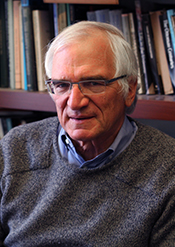
Congratulations to Department of Earth, Planetary, and Space Sciences Professor Ed Young who has been named a Fellow of the Geochemical Society and of the European Association of Geochemistry. The award is “bestowed upon outstanding scientists who have, over some years, made a major contribution to the field of geochemistry”. Ed will be honored at the Goldschmidt meeting in Yokohama this summer.
I present some novel insights based on first principles, parameterized 1D thermal history, and 3D spherical mantle convection evolution models, which raise doubt concerning many crucial assumptions commonly used in planetary geodynamics and allow for a new view on the thermal and tectonic evolution of rocky planets in our solar system and beyond.
The new approach leads to massive rocky planets (Earth and bigger) remaining hotter for longer and plate tectonics being ideally initiated early on in the first 0.1-1Gyr driven by core cooling and boosted by a dry mantle and a late delivery of oceans. The latter suggests that geodynamically the early Earth might have been in many ways similar to today and connects the origins of plate tectonics to planet formation. For Venus, the high surface temperatures and a lack of surface oceans allow to initiate but not to maintain plate tectonics – suggesting an unstable tectonic configuration.
This evolutionary interior and tectonic framework also opens a door to systematically connect geodynamics to the evolution of metabolic pathways and the origins of life. In this context, I show preliminary results on the time-dependent (and for Mars and Earth local) geodynamic formation of hydrogen and methane rich oases.
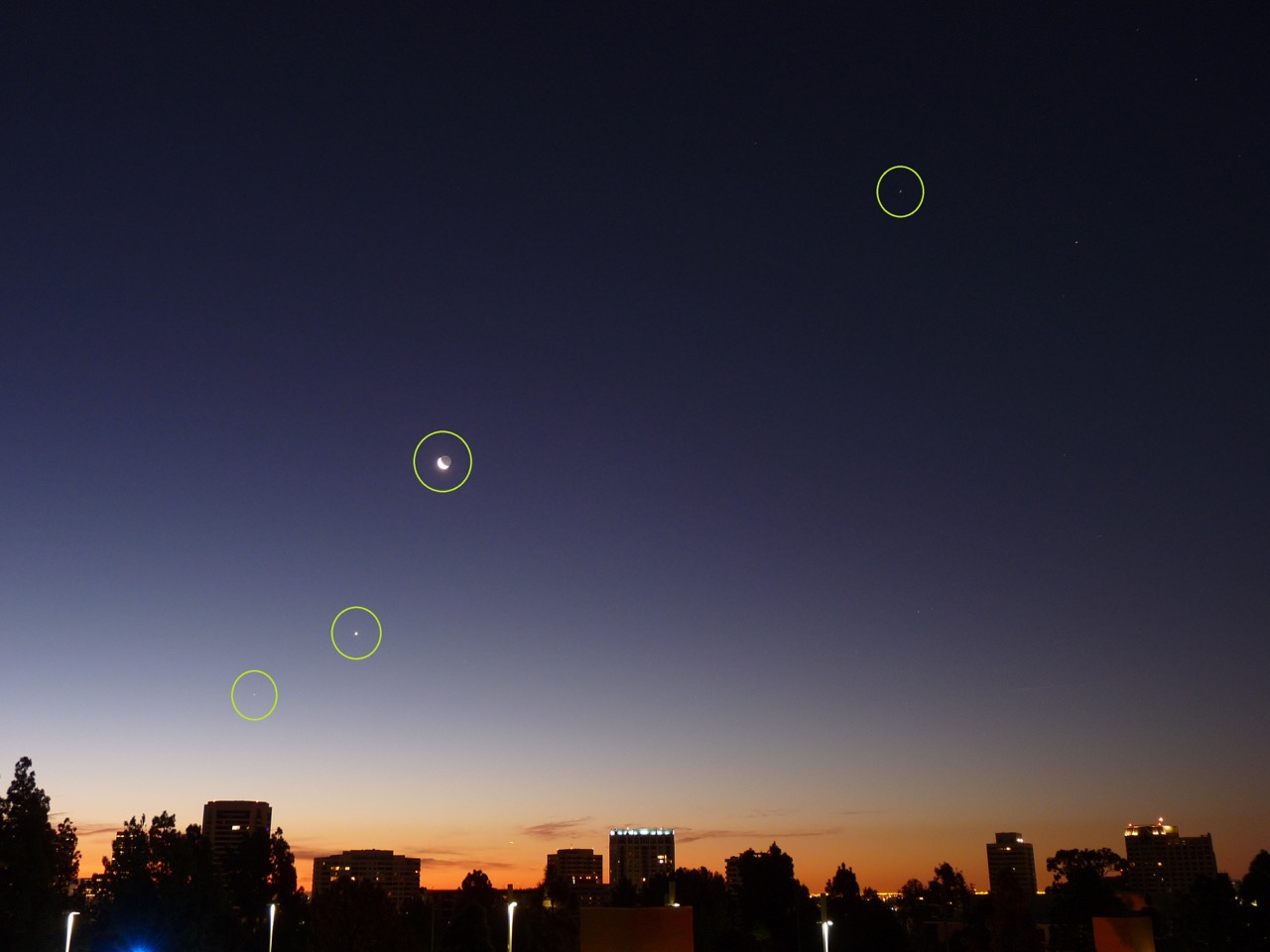
Photo from UCLA campus on February 2nd, 2016. From left to right: Mercury, Venus, Saturn, Mars, the Moon, and Jupiter. Photo credit: James Weygand
Late January and early February have provided spectacular views of the planets in the early morning sky. It is the first time that the bright planets that can be seen with the naked eye have been simultaneously visible since 2005. In their outward order from the sun, the five bright planets are Mercury, Venus, Mars, Jupiter and Saturn. They are visible because they are large and relatively close compared with other celestial objects like stars. Their surfaces and disks reflect sunlight and shine steadily, compared to the distant twinkling light that emanates from stars.
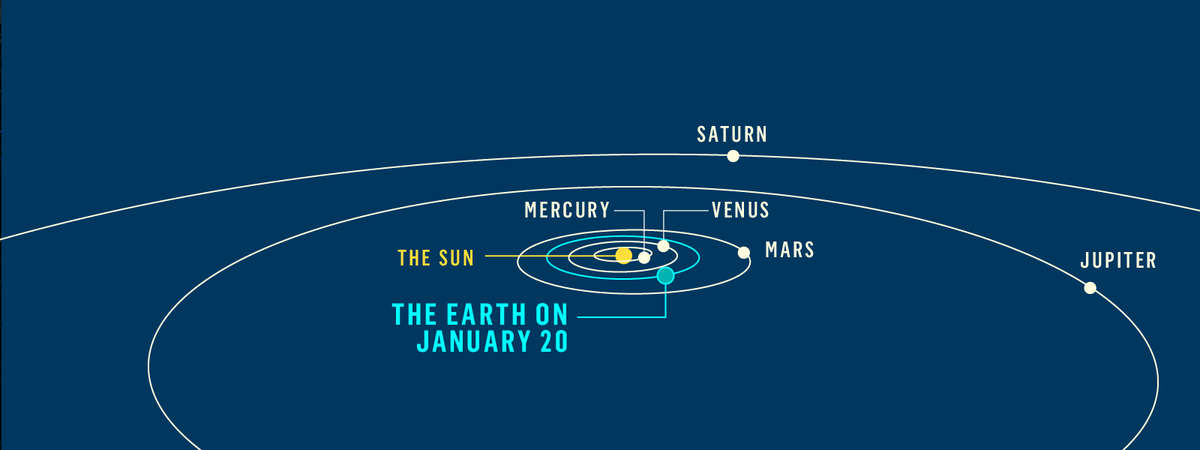
Many of the planets are visible before dawn, however, it is only at twilight that you can catch all five planets because of their orbital location around the Sun. This is because of the planets’ relative positions in their orbits. Currently, all of the planets are located on the same side of the Sun (to the right when viewing the solar system from above), which means that as the Earth rotates they are all visible just before the sun rises over the eastern horizon. That means that the planets are also visible from almost anywhere on the globe, with the exception of the poles.
The five planets are visible all at the same time because from the Earth’s perspective they all lie to the right of the sun. So they rise one after another—Jupiter, then Mars, then Saturn, then Venus, and finally Mercury. Last, the sun rises and makes all five disappear with its morning rays. Image Credit: Katie Peek/Popular Science
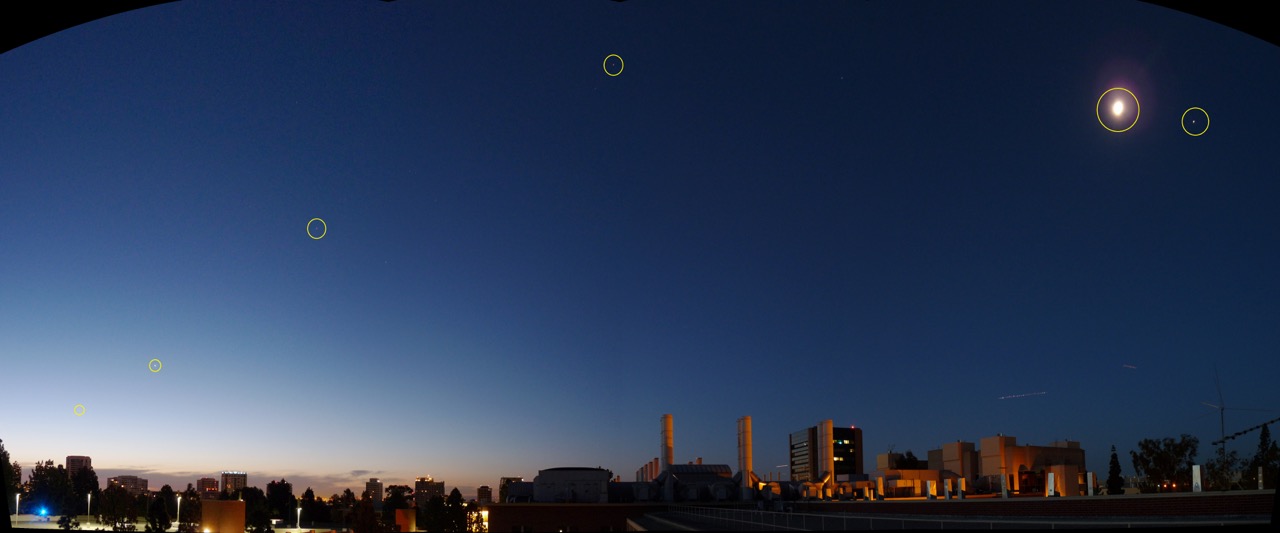
You can continue to see the planets in close to dawn until mid-February, and can take spectacular photos using a long exposure setting on your camera. The photos here are taken from the UCLA Campus, taken by UCLA researcher James Weygand. If you look very closely, you can see a sixth planet (hint: the photographer is standing on it!). To see more photos like this from around the world here: EarthSky.
Detecting polarized light from self-luminous exoplanets has the potential to provide key information about rotation, surface gravity, cloud grain size, and cloud coverage. While field brown dwarfs with detected polarized emission are common, no exoplanet or substellar companion has yet been detected in polarized light. With the advent of high contrast imaging spectro-polarimeters such as GPI and SPHERE, such a detection may now be possible with careful treatment of instrumental polarization. I will discuss the role of polarimetry in brown dwarf and exoplanet science, test observations with GPI, as well as current and future polarimetric observing campaigns.
It is with sadness that we report the passing of UCLA professor and distinguished astronomer, Michael Jura. A facet to the Department of Physics and Astronomy and an active member of iPLEX, Mike always encouraged the interdisciplinary blending of planetary science and astronomy. He made major contributions to the fields of theoretical and observational astronomy and was influential in the development of infrared astronomy and the Infrared Laboratory at UCLA, which now has instruments in many terrestrial and space telescopes. His presence will be missed in both the fields of astronomy and planetary science and within the UCLA community.
We leave you with a brief video that Mike recorded for iPLEX in 2012 explaining his attraction to science at a young age and the wonder that he held for studying the cosmos, in particular white dwarfs.
Many hot Jupiter systems exhibit significant misalignment between the orbital axis of the planet and the spin axis of its host star. While this misalignment could be primordial in nature, a large fraction of hot Jupiters are found in systems with distant stellar companions, and thus could have undergone Lidov-Kozai (LK) oscillations and acquired their misalignment dynamically. Here we present a study of the effect of spin-orbit coupling during LK oscillations, and the resulting spin-orbit misalignment angle distributions. We show that spin-orbit coupling induces complex, often chaotic, behavior in the spin axis of the host star, and that this behavior depends significantly on the mass of the planet and the properties of the host star (mass and spin history). We develop a semi-analytical framework that successfully explains most of the possible stellar spin behaviors. We then present a comprehensive population synthesis of hot Jupiters created via the LK mechanism, and discuss their possible observable signatures.

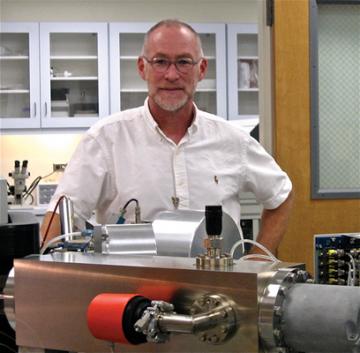 Congratulations to Department of Earth, Planetary, and Space Sciences Professor Ed Young who has been named a Fellow of the Geochemical Society and of the European Association of Geochemistry. The award is “bestowed upon outstanding scientists who have, over some years, made a major contribution to the field of geochemistry”. Ed will be honored at the Goldschmidt meeting in Yokohama this summer.