
The first observation of a chemically produced mass independent process suggested application to the early solar system, which remains relevant to date. In the subsequent development of a quantum mechanical understanding of the isotopic process, numerous applications in the terrestrial atmosphere arose. At present, with the exception of water, every oxygen bearing species in the Earths atmosphere is mass independent and does not lie on the so called terrestrial fractionation line, with species both above and below the fractionation line defined by silicate rocks. In each case, new information on source strengths and transport and chemical transformation is provided that would otherwise have been unrecognized. One of the least understood components of global climate is the role of aerosol particles. The application of mass independent isotope measurements has lead to new insights into this issue. Specific aspects of the role of particles with ozone has been particularly important as the role of chemically transformation is captured. What is more important is that the record is stable and the change over time is recorded and ice core samples provide the only paleo ozone record available. Finally, measurements of Martian meteorites secondary minerals may be better interpreted from combined laboratory, atmospheric, and ice core and geologic record. Recent measurements will be discussed
April 18, 2013: Understanding and Predicting the Dynamic Sun and Heliosphere
Despite almost a century of modern solar observations and over 50 years of space exploration, some of the fundamental problems in solar physics are not fully understood yet. The solar corona heating, the solar wind acceleration, the initiation and propagation of Coronal Mass Ejections (CMEs), and the solar cycle do not have a complete theoretical framework to describe and predict these phenomena. The lack of a complete theory, in addition to the large range of both spatial and temporal scales involved, make it challenging to develop numerical models for solar and space physics. Despite of the challenges, a great progress has been made in the last decade to develop numerical models for the solar corona, the solar wind , and CMEs. In my talk, I will describe a state of the art model for the solar corona and the solar wind, and I will demonstrate how the model can be used to improve our understanding on solar corona phenomena and observations.
April 25, 2013: Solar Activity, Coronal Heating, and the Acceleration of the Solar Wind: From now to Solar Probe Plus
The magnetic field is fundamental to solar activity and shapes the interplanetary environment, as clearly shown by the full three dimensional monitoring of the heliosphere provided by the measurements of the Helios, Ulysses, SOHO, ACE, Wind, STEREO, SDO and Voyager spacecraft. Magnetic fields are also the source for coronal heating and the very existence of the solar wind; produced by the sun’s dynamo and emerging into the corona, magnetic fields become a conduit for waves, act to store energy and then propel plasma into the heliosphere in the form of Coronal Mass Ejections (CMEs). Transformation of magnetic energy is also the source solar energetic particle events. The way in which solar convective energy couples to magnetic fields to produce the multifaceted heliosphere is at the heart of Solar Probe Plus (SPP) exploration. In this talk I will review the role played by the magnetic field in solar and heliospheric variability and solar atmospheric dynamics, including the coronal heating and solar wind acceleration problems. I will then highlight the exciting perspectives for discovery provided by SPP and other future missions to the inner heliosphere. Tests of current theoretical models of coronal heating and wind acceleration will be described and focus areas for further numerical and theoretical efforts illustrated.
iPLEX newsletter highlights planetary research at UCLA
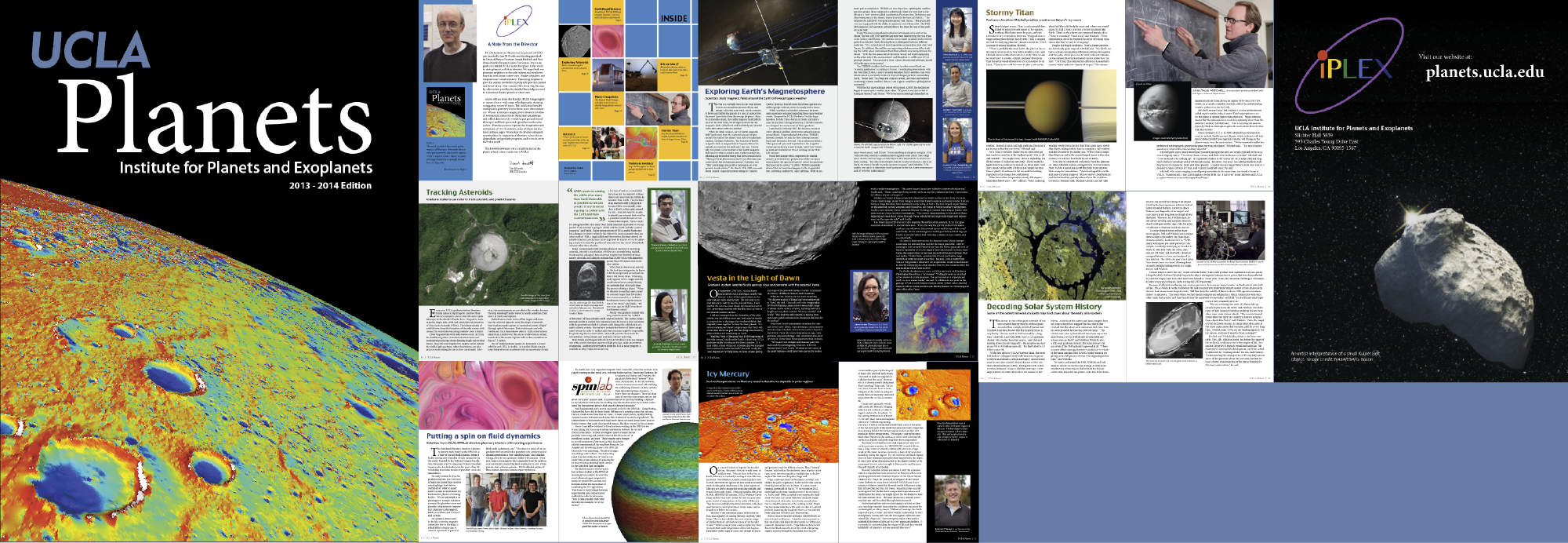
Distribution of the first annual iPLEX newsletter began on April 24, 2013. This 36-page publication highlights planetary research at UCLA undertaken by scientists from the Earth & Space Sciences, Astronomy, and Atmospheric & Oceanic Science departments, including the recent discovery of ice on Mercury, weather on Titan, and the Dawn spacecraft at Vesta. Also included is an update on the UCLA Meteorite Museum and a Q&A with Ashwin Vasavada, the deputy project scientist for the Mars Science Laboratory mission. Hard copies of the newsletter are available free of charge in the iPLEX office (Slichter 3839). An electronic version of the iPLEX newsletter is available for download from this site as a PDF document, which can be viewed in all major pdf viewers including iBooks on Apple devices. The e-version of the newsletter includes links to videos and websites for more information.
Jean-Luc Margot – Radar Astronomy and the Asteroid Impact Hazard
UCLA Professor Jean-Luc Margot explains how radar astronomy drastically improves the ability for humans to predict and mitigate asteroid impact hazards.
For more information about the UCLA’s Radar Astronomy Group, please visit: http://radarastronomy.org
Keck Institute for Space Studies Short Course: “Airships: A New Horizon for Science”
Keck Institute for Space Studies Short Course: “Airships: A New Horizon for Science”
The Keck Institute for Space Studies (KISS) invites all interested researchers, faculty and students to attend the following short course:
Airships: A New Horizon for Science
Tuesday, April 30, 2013
7:45 a.m. — Coffee and refreshments
8:15 a.m. – 2:00 p.m. — Short Course
Hameetman Auditorium, Cahill Building – Caltech
1216 E California Blvd., Pasadena, CA 91125
Introducing Key Science Opportunities from Airships in —
· Earth Sensing and Atmospheric Science – Randall Friedl (JPL)
· Planetary and Small Bodies Science – Geoff Blake (Caltech)
· Astrophysics – Mike Werner (JPL) / Paul Goldsmith (JPL)
And an Overview of the Complementarity and Advantages of Airships as a Science Platform from:
· Robert Fesen (Dartmouth)
· Steven Lord (Caltech/IPAC)
· Jens Kauffmann (Caltech), and
· Sarah Miller (Caltech/UCR)
We also invite all members of the scientific community to submit poster abstracts to sbryant [at] caltech [dot] edu by April 19th for a poster session to be held during an informal lunch for all short course attendees.
Posters should present ideas for unique science which could take advantage of airship platforms operating at low (<20,000 ft.), medium (20-40,000 ft) or high altitude (+60,000 ft). This includes any mission concepts or components which can take advantage of airship flight longevity (weeks to years at a time), payload flexibility and secure recovery, maneuverability, and ease of communication/data-retrieval, whether in Earth and Atmospheric Sciences, Solar Science, Planetary Science, Astrophysics, Cosmology, and/or Gravitational Wave Physics.
Students and postdocs are especially encouraged to submit poster abstracts.
An informal lunch will be provided to all short course attendees. There is no fee to attend, and no registration is required. More detailed schedule information for the short course is available here: http://kiss.caltech.edu/study/airship/index.html.
June 7, 2013: General Circulation Modeling of Close-In Exoplanet Atmospheres
Many exoplanets are on close-in orbits and are likely tidally synchronized. Atmospheric circulation affects the temperature distribution and thus transit observations of these planets. In particular, hot spots shifted by broad, steady, superrotating jets have been emphasized in the literature, but vortices can also play an important role. The scale of jets and vortices is expected to be large for this type of planets, which makes their possible time variability crucial. Our goal is to explore dominant circulation patterns and constrain conditions and mechanisms for variability on tidally locked exoplanets.
We use a general circulation model, solving the primitive equations with thermal relaxation. The parameter space relevant for tidally synchronized planets is explored, using the mini-Neptune GJ1214b and hot Jupiter HD209458b as reference planets. Furthermore, results are compared from models using different numerical algorithms and grids for a range of relevant test cases.
For a large range of conditions, robust features include a small number of jets and large-scale vortices. The vortices often exhibit time variability, associated with planetary scale waves, with corresponding variability in the position of relative hot and cold regions.
The results make a strong case for mission concepts such as ESA’s EChO, that emphasize repeated measurements of a given planet. The feedback between such observations and modeling offers an opportunity to gain new insights into exoplanet atmospheres from the time modulation of the signals, in addition to spatial variability.
May 23, 2013: Are high-density exoplanets the un-decompressed naked cores of gas giants?
Data extracted from the Extrasolar Planets Encyclopaedia (http://exoplanet.eu) show the existence of planets that are more massive than same-size iron cores. After meticulous verification of the data, we have concluded that the mass of the smallest of these planets was actually unknown. However, three high-density planets, Kepler-52b, Kepler-52c, and Kepler-57b, which are between 30 and 100 times the Earth mass, have indeed density larger than asame-size iron planet. This observation triggered the present study that investigates under which conditions these planets could represent the naked cores of gas giants that would have lost their atmospheres during their migration towards the star. The bulk viscosity of the cores of giant planets can indeed be large enough to hold a very high density during geological timescales. This would make those planets a new kind of planets which, in return, would provide useful information on the interior structure of the gas giants.
May 23, 2013: Enceladus’ jets and Titan’s organics: latest news from Cassini
The active cryovolcanism on Enceladus and the formation of heavy organic molecules in Titan’s atmosphere are two major unrelated discoveries of the Cassini mission. These two end-member icy moons of Saturn reveal important processes for our understanding of the evolution of icy moons and their habitability potential. New observations by the Visual and Infrared mapping spectrometer (VIMS) onboard the Cassini spacecraft provide additional constraints on the geological processes responsible for the formation of Enceladus’ jets. The very strong correlation between the brightness of the overall plume and the true anomaly suggests a very strong control by tidal forces as expected by previous models. On Titan, the solar occultation observations provide constraints on the composition of the organic haze by comparing their spectral properties with those of heavy organic molecules synthetized in laboratory experiments simulating Titan’s conditions. These observations also give density profiles from which one can derive the flux of organic particle falling on Titan’s surface. These observations are included in a global model describing the carbon cycle on Titan and the relationships between the different reservoirs including atmospheric methane, organic haze, lakes, seas, dune fields, subsurface clathrate hydrates and a potential deep reservoir.
May 2, 2013: Jupiter and Saturn structure models with few layers
Our understanding of Jupiter and Saturn goes hand in hand with the availability and accuracy of observational constraints as well as of the equations of state for their main constituents, hydrogen and helium. We show how the current uncertainties in the core mass of Jupiter (0-10 ME) and Saturn (0-20 ME) could be reduced with the help of measured atmospheric oxygen abundances, which is in reach for Jupiter thanks to the Juno mission, and possibly also for Saturn. Given that both planets’ atmospheres are observed to be depleted in helium, we finally discuss the occurrence of H/He demixing with respect to recent ab initio data based H/He phase diagrams and argue that the assumption a layered structure with few layers remains a reasonable approximation. However, we caution that the derived total heavy element fraction is highly subject to our assumption of an adiabatic interior, which may not hold in case of He demixing.